Why Ages 0–6 Matter More Than Most Parents Realize
The Most Important Years Are Often the Most Overlooked
Many parents believe real education begins when children start school.
But long before a child enters a classroom, something extraordinary is happening.
From birth to age six, a child’s brain develops faster than at any other time in life.
During these years, children are not simply learning words, numbers, or colors.
They are building the foundation for how they think, feel, communicate, learn, and interact with the world.
The habits, experiences, relationships, and environments children encounter during these early years can influence them for decades.
That is why ages 0–6 matter more than most parents realize.
In This Article
✓ Why the first six years are so important
✓ How children learn through observation
✓ What parents often misunderstand
✓ What children truly need during these years
✓ Practical ways to support healthy development
The Foundation Years
Imagine building a house.
Most people admire the roof, walls, and beautiful design.
But none of those things matter if the foundation is weak.
Child development works the same way.
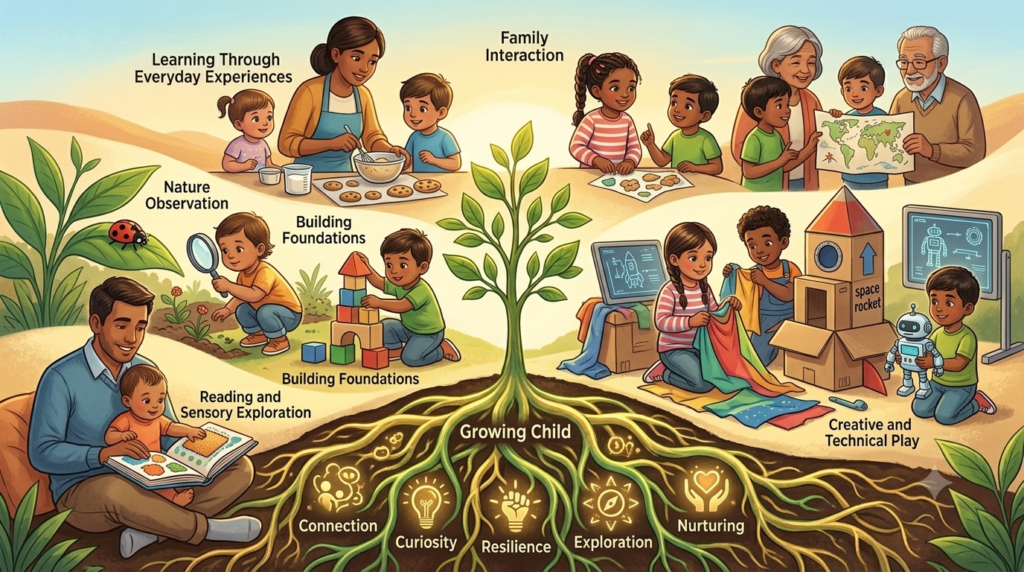
The first six years form the foundation upon which future learning, behavior, confidence, relationships, and success are built.
What happens during these years often influences everything that follows.
Children may forget what we tell them, but they rarely forget what we show them.
— Namaora Thought
The Brain Develops Rapidly
A child’s brain is incredibly active during the early years.
Every experience helps create connections.
Every conversation builds language.
Every interaction shapes emotional development.
Every story strengthens imagination.
Every moment of play supports learning.
Children are not waiting to learn.
They are learning all the time.
The Power of Observation
One of the most important truths parents should understand is this:
Children Learn More Through Observation Than Instruction
Before children can fully understand explanations, they watch.
They observe:
How adults speak
How people solve problems
How emotions are expressed
How conflicts are handled
How technology is used
How kindness is shown
The world becomes their classroom.
Parents become their first teachers.
Daily life becomes their curriculum.
What Many Parents Misunderstand
Many parents worry about:
- Reading early
- Writing early
- Memorizing information
- Academic performance
While these skills have value, they are not the most important priorities during ages 0–6.
Children first need:
- Security
- Love
- Conversation
- Play
- Exploration
- Movement
- Social interaction
- Curiosity
A child who develops these foundations often learns academic skills more effectively later.
What Children Need Most During Ages 0–6
Meaningful Conversations
Language develops through interaction.
Talk with children often.
Ask questions.
Listen carefully.
Encourage communication.
Unstructured Play
Play is not a break from learning.
Play is learning.
Through play, children develop:
Creativity
Problem-solving
Social skills
Independence
Real-World Experiences
Children learn from everyday life.
Cooking.
Gardening.
Shopping.
Walking.
Helping at home.
These experiences teach far more than many worksheets.
Reading Together
Books help children develop:
Language
Imagination
Attention span
Emotional understanding
Reading regularly creates lifelong learners.
Emotional Safety
Children learn best when they feel safe, supported, and loved.
Emotional security becomes the foundation for confidence and learning.
Signs of Healthy Early Development
Children do not need to know everything.
Instead, look for signs such as:
✓ Curiosity
✓ Asking questions
✓ Exploring independently
✓ Communicating thoughts
✓ Showing empathy
✓ Solving simple problems
✓ Enjoying learning experiences
These are often stronger indicators of future success than early academic achievement.
Common Mistakes Adults Make
Avoid:
❌ Comparing children
❌ Over-scheduling every minute
❌ Excessive screen exposure
❌ Focusing only on academics
❌ Solving every problem for children
❌ Expecting perfection
Children need guidance, not pressure.
A Simple Daily Formula
Parents often ask:
“What is the best thing I can do for my child?”
The answer is surprisingly simple:
Every day try to provide:
✓ Conversation
✓ Play
✓ Reading
✓ Movement
✓ Exploration
✓ Connection
These six experiences create powerful learning opportunities.
Key Takeaways
- ✓ Ages 0–6 are the foundation years of development.
- ✓ Children learn primarily through observation and experience.
- ✓ Play is one of the most important forms of learning.
- ✓ Parents are a child’s first and most influential teachers.
- ✓ Emotional security supports healthy development.
- ✓ Small daily interactions have long-term impact.
Pause & Reflect
Think about the last 24 hours.
What did your child observe from you?
What experiences helped them learn, explore, or grow?
Sometimes the most powerful lessons happen during ordinary moments.
The Namaora Thought
The first six years do not determine a child’s future, but they help build the foundation upon which that future is created.
Continue Your Learning Journey
The early years are filled with opportunities to shape curiosity, confidence, and character.
Explore more Namaora articles on parenting, child development, play-based learning, and future-ready skills.
Next Recommended Article
👉 Play Is Not a Waste of Time: It’s Learning
This article naturally follows and will strengthen Namaora’s early learning philosophy while attracting parents, teachers, and Montessori-focused audiences.