
NAMAORA FOR TEACHERS
Inspiring Teachers for a Changing Generation
Teaching is changing. Children are changing. And the world they are preparing for is changing too.
Namaora supports teachers with practical ideas, child-centered approaches, Montessori-inspired practices, and future-ready learning strategies—without losing the human connection at the heart of teaching.
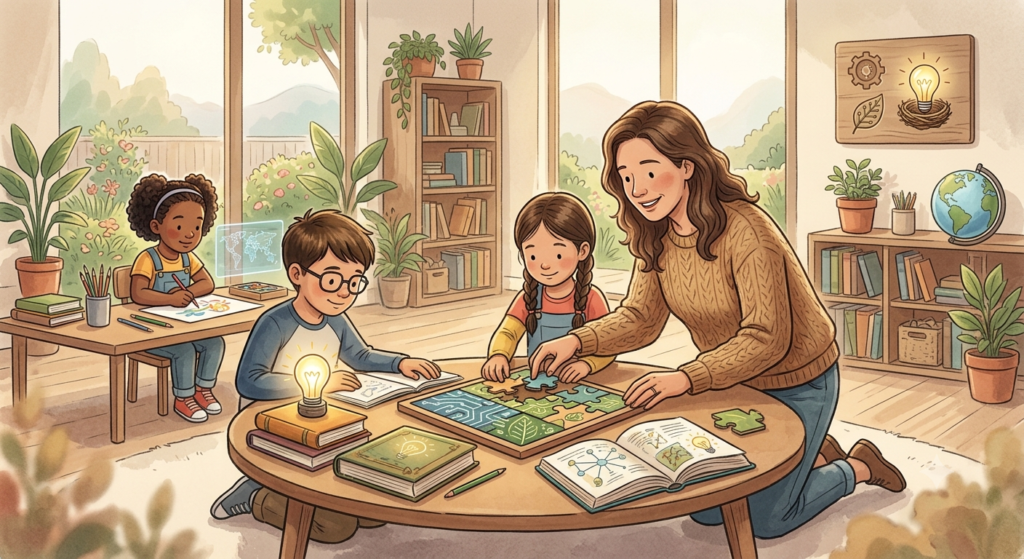
THE CLASSROOM IS CHANGING
Teaching Has Changed. So Have the Challenges.
Children are growing up in a world of instant information, digital stimulation, AI, interactive media and rapidly changing expectations. Teachers are being asked to do more than deliver lessons—they are helping children learn how to think, connect, create and adapt.
Changing Attention
Children are growing up surrounded by notifications, short-form videos, games and constant digital stimulation. Helping them slow down, concentrate and engage deeply has become an important part of learning.
👁️
Changing Expectations
Today’s learners often want to participate, question, create and explore—not simply listen and remember. Classrooms increasingly need opportunities for curiosity, interaction and meaningful participation.
💡
Technology & AI
Technology can expand what teachers and children can do, but it also brings new questions about responsible use, digital habits, accuracy and learning. Teachers are becoming guides for navigating this new environment.
✨
More Than Marks
Teachers are expected to support academic progress while also nurturing confidence, relationships, creativity, emotional development and independence. Helping the whole child matters alongside achievement.
🧘
Every Child Is Different
Children bring different interests, experiences, strengths, personalities and ways of engaging with learning. A responsive classroom makes room for those differences instead of expecting every child to learn in exactly the same way.
👥
Preparing for an Uncertain Future
Memorization alone cannot prepare children for a world that continues to change. They also need curiosity, communication, creativity, critical thinking, collaboration and the confidence to adapt.
🌐
THE HUMAN SIDE OF LEARNING
Why Teachers Matter More Than Ever
Technology can provide information.
AI can answer questions.
But teachers provide understanding, encouragement, context, empathy, guidance and human connection.
Understanding
Encouragement
Context
Empathy
Guidance
Human Connection
👁️ Understanding
See the child behind the behaviour.
✨ Encouragement
Help children believe they can.
🧭 Context
Connect knowledge to real life.
💛 Empathy
Make children feel seen and valued.
🌱 Guidance
Help children discover their own way.
🤝 Human Connection
Build relationships that technology cannot replace.
THE NAMAORA APPROACH
A Different Way to Think About Teaching
Great teaching begins with understanding the child—not simply delivering the lesson.
The Namaora Teacher Framework™ brings together observation, connection, guidance and inspiration to help teachers create learning environments where children can become curious, confident and increasingly independent.
01
👁️
NOTICE
Look before you lead.
Observe what interests the child, what captures their attention and how they respond to the learning environment.
02
🔎
UNDERSTAND
Look beyond the behaviour.
Ask what the child’s behaviour, questions or reactions may be telling you about their needs and experiences.
03
🤝
CONNECT
Build trust before demanding attention.
Create relationships where children feel respected, heard and comfortable enough to participate, question and make mistakes.
04
🧭
GUIDE
Support discovery.
Offer the right amount of help while giving children opportunities to explore, solve problems and find their own answers.
05
✨
INSPIRE
Make curiosity part of the classroom.
Encourage children to ask questions, explore possibilities, create ideas and discover that learning can be meaningful and enjoyable.
06
🌱
EMPOWER
Grow confident, independent learners.
Help children develop the confidence, skills and independence to take increasing ownership of their learning.
Observe deeply. Connect genuinely. Guide thoughtfully. Empower completely.
MONTESSORI-INSPIRED TEACHING
Small Changes. More Meaningful Learning.
Montessori-inspired teaching is not about having a Montessori classroom. It is about seeing children as capable learners and creating opportunities for independence, concentration, exploration and discovery.
Even small changes in how we speak, guide and prepare the learning environment can make a meaningful difference.
01
👁
Observation
Watch before you intervene.
Notice what the child is trying, where they struggle and what captures their interest.
02
🌱
Independence
Let children do what they can for themselves.
Give children appropriate opportunities to choose, attempt, practise and complete tasks independently.
03
🏡
Prepared Environment
Make the environment work for the learner.
Organize materials so children can access, use and return them with increasing independence.
04
✋
Hands-On Learning
Let children learn by doing.
Whenever possible, turn abstract ideas into experiences children can touch, move, build, test or explore.
05
🧺
Practical Life
Connect learning with everyday life.
Simple real-world tasks can develop coordination, responsibility, concentration and confidence.
06
🌿
Child Choice
Offer meaningful choices within clear boundaries.
Give children appropriate opportunities to choose activities, materials or approaches while maintaining a purposeful learning environment.
07
🎯
Concentration
Protect the child’s ability to focus.
Reduce unnecessary interruptions and allow children enough uninterrupted time to become deeply engaged.
08
💛
Respect
Speak to children with dignity.
Treat children as capable individuals whose ideas, questions, mistakes and efforts deserve thoughtful attention.
09
🔄
Self-Correction
Let learning include discovery and reflection.
Whenever appropriate, create opportunities for children to notice mistakes, reconsider their approach and try again.
10
🌍
Learning Through Experience
Turn the world into a learning environment.
Connect lessons with real experiences, observation, movement, nature, conversation and exploration.
TRY A SMALL SHIFT
Sometimes, One Sentence Can Change the Learning Experience.
Montessori-inspired teaching doesn’t always require a major classroom transformation. Sometimes it begins with changing the way we respond to a child.
Instead of:
“Don’t touch that.”
“I’ll do it for you.”
“That’s wrong.”
“Sit quietly and listen.”
“Everyone do it this way.”
Try This:
“Let’s see what happens if we try it this way.”
“Would you like to try it first?”
“What do you notice? Would you like to try another way?”
“What do you think we should investigate?”
From one prescribed path → to thoughtful exploration
You don’t need to change everything. Start with one small shift.
One observation. One question. One opportunity for independence.
A NAMAORA TEACHER SUPERPOWER
Before Changing the Child, Understand the Child.
Observation is more than watching. It is the practice of slowing down, noticing patterns and becoming curious about what a child’s behaviour, interests and responses may be telling us.
When teachers observe before they intervene, they can respond with greater understanding—and create learning experiences that better meet the child where they are.
Look Beyond the Behaviour
A child who is distracted may be curious.
A child who keeps moving may need movement.
A child who avoids an activity may be communicating frustration.
A child who asks endless questions may be deeply engaged.
The behaviour is what we see. Observation helps us explore what may be underneath it.
What Are You Noticing?
The next time you observe a child, pause before reaching for a solution. Start with a question.
01
👁️
Interest
What captures their attention?
What activities, subjects, objects or questions make the child become especially engaged?
02
🎯
Concentration
When do they concentrate deeply?
Notice when the child becomes absorbed—and what conditions seem to support that focus.
03
⚠️
Frustration
What seems to cause frustration?
Look for moments when the child struggles, withdraws, rushes or becomes upset.
04
👥
Interaction
How do they interact with others?
Observe how the child communicates, collaborates, responds to others and participates in group experiences.
05
⬆️
Motivation
What makes them want to keep trying?
Notice what encourages persistence, curiosity and willingness to try again.
06
.
Learning Approach
What approaches seem to help?
Notice whether movement, conversation, demonstration, hands-on experiences, visual materials or other approaches appear to support engagement.
PUT OBSERVATION INTO PRACTICE
Observe → Wonder → Respond → Reflect
OBSERVE
What is happening?
WONDER
What might this be telling me?
RESPOND
What small change could I try?
REFLECT
What happened next?
Good observation doesn’t end with noticing. It helps us make thoughtful decisions—and learn from what happens next.
Especially in the early years, observation matters.
During ages 0–6, children are rapidly developing language, movement, social skills, emotional understanding, curiosity, independence, concentration and practical life skills. Careful observation can help adults notice how children are developing and where meaningful opportunities for support and exploration may exist.
The more carefully we observe, the more thoughtfully we can teach.
THE MODERN CLASSROOM
From Teaching Content to Creating Learning
The role of a teacher is not only to explain what children need to know. It is also to create experiences that help them discover, question, connect and apply what they learn.
Structured teaching, explanation and practice all have an important place in education. The opportunity is to complement them with moments where children can explore ideas, make connections, ask questions and take greater ownership of their learning.
A Familiar Learning Pattern
A More Active Learning Experience
Teacher Explains
↓
Child Listens
↓
Child Practices
↓
Child Remembers
↓
Assessment
Teacher Observes
↓
Child Explores
↓
Teacher Guides
↓
Child Questions
↓
Child Creates
↓
Child Reflects
A structured approach can provide clarity, knowledge and essential foundations.
Adding exploration, questioning and reflection can help children move from receiving knowledge to actively engaging with it.
Small Shifts Can Create More Active Learners
Ask Before You Explain
Instead of immediately giving the answer, invite children to think first.
“What do you think might happen?”
Let Children Explore
Give children opportunities to investigate ideas through materials, questions and experiences.
“What happens if we change one part?”
Connect Learning to Life
Help children see where classroom knowledge exists in the real world.
“Where might we use this outside the classroom?”
Make Room for Questions
A child’s question can become the beginning of meaningful learning.
“That’s an interesting question. How could we find out?”
End With Reflection
Give children a moment to think about what they discovered.
“What did you notice?”
THE TEACHER AS GUIDE
The Teacher Doesn’t Disappear. The Teacher Becomes More Intentional.
Active learning does not mean leaving children to figure everything out alone. The teacher remains central—observing, explaining when needed, asking thoughtful questions, providing structure, introducing new ideas and knowing when to step back.
Explain
Provide clarity when children need new knowledge or understanding.
Question
Use thoughtful questions to deepen thinking.
Guide
Offer the right amount of support without taking over.
Step Back
Give children space to try, explore and discover independently.
What Could This Look Like?
Growing a Plant 🌱
“Today we are learning about what plants need to grow.”
Observe
What do children notice about the plant?
Question
“What do you think plants need?”
Explore
Give children opportunities to investigate light, water and soil.
Predict
“What do you think will happen if…?”
Observe Again
What changes over several days?
Reflect
“What did we discover?”
The lesson is no longer only about learning what a plant needs. It becomes an opportunity to observe, question, investigate, predict and reflect.
Don’t just give children answers.
Give them opportunities to discover.
Teach the knowledge. Create the experience. Guide the discovery.
PREPARING CHILDREN FOR THE FUTURE
What Children Need Beyond the Textbook
Children will enter a world that continues to change through technology, artificial intelligence, new careers and new ways of working. While knowledge remains essential, children also need the ability to think independently, communicate clearly, work with others, solve problems and adapt to unfamiliar situations.
A future-ready classroom does not try to predict exactly what tomorrow will look like. It helps children develop the confidence and capabilities to navigate whatever comes next.
Curiosity
The desire to ask questions and explore beyond the obvious.
Encourage children to wonder, investigate and discover.
Critical Thinking
The ability to examine information, consider possibilities and make thoughtful decisions.
Teach children how to think—not simply what to think.
Creativity
The confidence to imagine possibilities and develop original ideas.
Give children space to experiment, create and see things differently.
Communication
The ability to express ideas, listen carefully and understand different perspectives.
Meaningful conversation is part of meaningful learning.
Collaboration
The ability to work with others, contribute ideas and learn together.
Learning doesn’t always have to happen alone.
Adaptability
The confidence to learn, adjust and try again when circumstances change.
Help children see mistakes and challenges as opportunities to learn.
A Future-Ready Child Needs More Than Skills
KNOWLEDGE
What I know
Foundational knowledge, literacy, numeracy, science, culture and understanding of the world.
SKILLS
What I can do
Thinking, communicating, creating, collaborating, problem-solving and learning independently.
CHARACTER
How I show up
Curiosity, kindness, responsibility, resilience, empathy, integrity and respect.
Knowledge gives children a foundation. Skills help them navigate the world. Character helps them use both wisely.
START SMALL
You Don’t Need to Redesign Your Entire Classroom
Future-ready learning can begin with small changes to everyday teaching.
Instead of:
“What is the correct answer?”
“Follow these steps.”
“Finish the activity.”
“That’s incorrect.”
“Remember this.”
Try This:
“How did you arrive at your answer?”
“Can you think of another way?”
“What could you create with what you’ve learned?”
“What could you try next?”
These connect directly with the observation and active-learning sections you’ve already built.
A Classroom Where Children Learn to Think
QUESTION → EXPLORE → CREATE → COLLABORATE → Reflect
The future-ready classroom is not defined by how much technology it contains. It is defined by the quality of thinking, participation and learning taking place within it.
We cannot predict the future for our children.
But we can help them become ready for it.
Teach knowledge. Build skills. Nurture character. Encourage curiosity.
AI & THE TEACHER
AI Can Assist the Teacher. It Cannot Replace the Teacher.
Artificial intelligence is becoming part of the world children are growing up in—and it is increasingly entering classrooms too. For teachers, AI can become a useful assistant for planning, brainstorming, adapting ideas and exploring new possibilities.
But good teaching involves far more than producing information. Understanding a child, building trust, noticing subtle changes, making thoughtful decisions and knowing when to encourage, challenge or simply listen are deeply human responsibilities.
Use AI to extend what a teacher can do—not to replace what a teacher brings.
Where AI Can Be a Helpful Teaching Assistant
AI can save time and generate possibilities, but the teacher remains responsible for deciding what is appropriate, accurate and meaningful for their learners.
01
Lesson Ideas
Brainstorm activities, examples and approaches for a lesson.
“Give me five hands-on ways to introduce fractions to a group of 9-year-olds.”
02
Differentiation
Explore different ways of presenting the same concept for different learners.
“How could I explain this concept using a story, visual example and hands-on activity?”
*AI can suggest approaches; the teacher decides what actually suits the child.*
03
❓
Question Generation
Create questions that encourage deeper thinking.
“Give me open-ended questions about this science topic.”
04
🎯
Activity Inspiration
Generate ideas for experiments, projects, discussions and creative activities.
“Suggest a simple classroom investigation using everyday materials.”
05
Resource Adaptation
Help transform existing teaching material into different formats or levels of complexity.
“Rewrite this explanation using simpler language for younger learners.”
*Again, teacher review is essential.*
06
Reflection & Planning
Use AI as a brainstorming partner when reflecting on lessons or planning what to try next.
“What are some alternative approaches I could consider if children are struggling with this activity?”
WHAT AI CANNOT REPLACE
The Most Important Parts of Teaching Are Human.
AI can sometimes produce information that is incomplete, inaccurate, outdated or unsuitable for a particular context. Teachers should review AI-generated content before using it with children.
Knowing the Child
A teacher sees the individual child —not just the learning objective.
Building Trust
Children learn differently when they feel safe, respected and understood.
Reading the Moment
A teacher can notice hesitation, excitement, frustration or confidence in the moment.
Making Judgments
Teaching requires professional judgment about what to introduce, change, pause or revisit.
Encouraging Courage
Sometimes children need someone to believe in them before they believe in themselves.
Being Present
A teacher can listen, respond, connect and build relationships.
AI can generate an answer. A teacher helps a child make meaning from it.
THINK OF AI AS A TEACHING ASSISTANT
ASK → REVIEW → ADAPT → APPLY → REFLECT
ASK
Use AI to explore possibilities.
REVIEW
Check the information, accuracy and suitability.
ADAPT
Make the idea appropriate for your learners.
APPLY
Use your professional judgment to bring it into the classroom.
REFLECT
Observe what happened and decide what to do next.
USE AI THOUGHTFULLY
A Helpful Tool Still Needs Human Oversight
AI can sometimes produce information that is incomplete, inaccurate, outdated or unsuitable for a particular context. Teachers should review AI-generated content before using it with children.
Check
Verify important information before sharing it.
Protect
Avoid entering children’s private or identifying information into AI tools.
Question
Treat AI output as a suggestion—not automatically as fact.
Decide
The teacher makes the final decision about whether something belongs in the learning experience.
Responsible AI use begins with human judgment.
TRY THIS WITH AI
Turn One Lesson Into Three Learning Experiences
Choose a topic you already teach. Ask AI to suggest three different ways children could explore it:
Explore
A hands-on investigation.
Create
A creative project or challenge.
Discuss
An open-ended conversation.
You choose what fits your children, your classroom and your learning goals.
The future of education isn’t human versus AI.
It’s humans using technology wisely.
Let technology handle possibilities. Let teachers lead the learning.
TEACHER RESOURCE HUB
Practical Resources for Your Everyday Teaching
Teachers don’t always need another theory. Sometimes they need a useful idea they can try tomorrow.
The Namaora Teacher Resource Hub brings together practical ideas, classroom activities, observation tools, teaching approaches and learning resources designed to help teachers save time, explore new possibilities and create meaningful learning experiences.
Simple enough to use. Thoughtful enough to make a difference.
01
💡
Classroom Ideas
Practical activities, teaching approaches and ideas you can adapt for your classroom.
Activity ideas
Discussion prompts
Classroom challenges
Learning games
Project ideas
02
👁
Child Observation
Tools that help teachers notice interests, behaviours, engagement and learning patterns.
Observation sheets
Observation prompts
Reflection templates
Learning notes
03
🖐
Montessori-Inspired
Simple ways to bring independence, hands-on learning and purposeful activity into everyday teaching.
Montessori-inspired activities
Practical life ideas
Prepared environment tips
Independence activities
04
🧭
Future-Ready Learning
Ideas that encourage curiosity, creativity, critical thinking, communication and collaboration.
Problem-solving activities
Creativity challenges
Inquiry prompts
Collaboration activities
Reflection exercises
05
🧠
AI for Teachers
Practical guidance for using AI thoughtfully as a teaching assistant.
AI prompts for teachers
Lesson brainstorming
Activity generation
Differentiation ideas
Responsible AI guidance
06
📄
Free Downloads
Ready-to-use printable resources designed to support teachers and learning experiences.
Observation sheets
Classroom checklists
Reflection sheets
Activity planners
Teacher guides
FEATURED TEACHER RESOURCE
Start With Observation
Before changing a learning experience, start by understanding the learner. Use simple observation prompts to notice what captures attention, what creates engagement and where a child may need additional support.
Child Observation Starter Sheet
A simple tool to help teachers pause, observe and reflect before deciding what to do next.
FIND YOUR NEXT RESOURCE
What Are You Looking For?
Explore resources based on what you need for your classroom, your learners or your own teaching journey.
ONE IDEA FOR TOMORROW
Give Children One More Opportunity to Think
During your next lesson, pause before giving an answer.
“What do you think?”
Give children a few moments to think, share possibilities and listen to one another.
Sometimes a small change in the question can change the learning experience.
Keep Exploring. Keep Experimenting. Keep Learning.
Teaching is a journey. Namaora is here to give you ideas, tools and inspiration along the way.
TEACHER INSIGHTS
Ideas for Teachers Who Keep Learning
Great teachers are lifelong learners. Explore practical insights, thoughtful perspectives and classroom ideas designed to help you understand children, rethink learning and grow your practice.
Read something useful today. Try something different tomorrow.
TEACHING
How Children Learn Through Observation, Experience and Play
Children don’t learn only when they are being taught. They learn through what they observe, experience, question, practise and discover. Understanding these everyday learning moments can help teachers create richer educational experiences.
More Teacher Insights
Child Development
Why Ages 0–6 Matter More Than We Realize
Early childhood development and why teachers should understand the importance of the early years.
Learning Through Play
Play Is Not a Waste of Time
How play supports exploration, creativity, problem-solving and meaningful learning.
Digital Wellness
Helping Children Build Healthier Screen Habits
Helping adults guide children’s relationship with digital technology.
EXPLORE BY TOPIC
Don’t Just Read. Try One Thing.
Every Namaora article should give you an opportunity to take a small idea into real life.
Read → Reflect → Try → Observe → Learn
Keep Learning With Namaora
Explore more stories, ideas and practical guidance for parents, teachers and children.
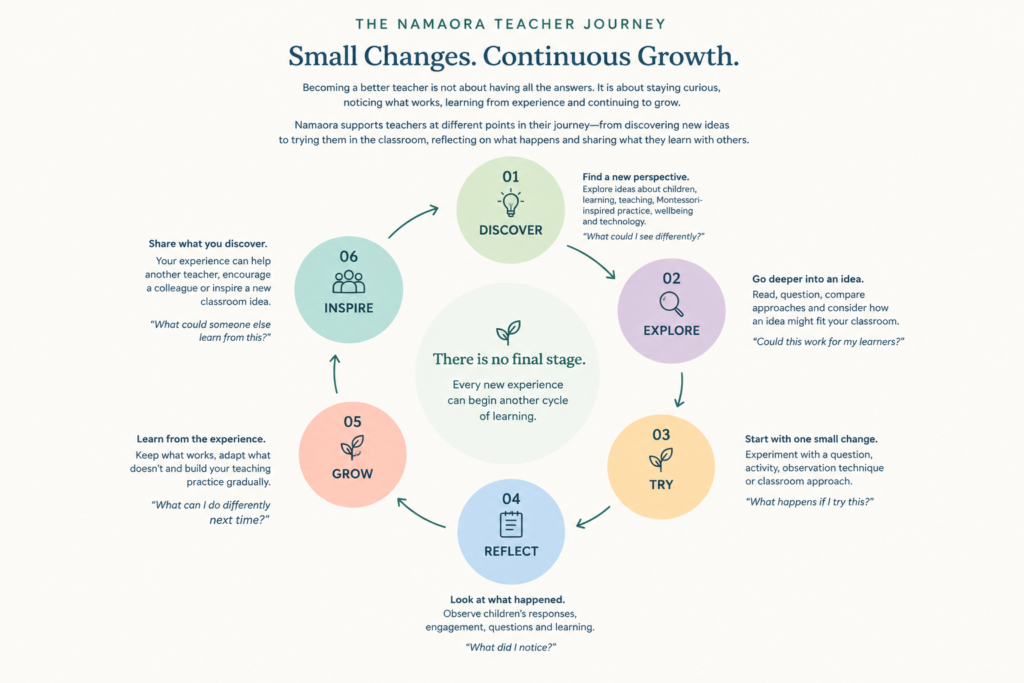
YOUR NAMAORA TEACHER JOURNEY
Small Changes. Continuous Growth.
Becoming a better teacher is not about having all the answers. It is about staying curious, noticing what works, learning from experience and continuing to grow.
Namaora supports teachers at different points in their journey—from discovering new ideas to trying them in the classroom, reflecting on what happens and sharing what they learn with others.
DISCOVER → EXPLORE → TRY → REFLECT → GROW → INSPIRE
DISCOVER
Find a new perspective.
Explore ideas about children, learning, teaching, Montessori-inspired practice, wellbeing and technology.
“What could I see differently?”
EXPLORE
Go deeper into an idea.
Read, question, compare approaches and consider how an idea might fit your classroom.
“Could this work for my learners?”
TRY
Start with one small change.
Experiment with a question, activity, observation technique or classroom approach.
“What happens if I try this?”
REFLECT
Look at what happened.
Observe children’s responses, engagement, questions and learning.
“What did I notice?”
GROW
Learn from the experience.
Keep what works, adapt what doesn’t and build your teaching practice gradually.
“What can I do differently next time?”
INSPIRE
Share what you discover.
Your experience can help another teacher, encourage a colleague or inspire a new classroom idea.
“What could someone else learn from this?”
Where Are You in Your Journey?
You don’t have to start at the beginning. Start wherever you are.