Play Is Not a Waste of Time: It’s Learning
What If Play Is the Most Important Learning Activity?
Imagine a child building a tower with blocks.
To an adult, it may look like simple play.
But inside that moment, something remarkable is happening.
The child is experimenting.
Problem-solving.
Testing ideas.
Developing patience.
Learning persistence.
Improving coordination.
Building confidence.
What appears to be “just play” is actually a powerful learning experience.
Unfortunately, many adults underestimate the value of play because it does not always look like traditional education.
Yet some of the most important lessons children learn happen while they are playing.
In This Article
✓ Why play is essential for development
✓ What children learn through play
✓ The difference between play and entertainment
✓ Common mistakes adults make
✓ Simple ways to encourage meaningful play
Why Children Are Naturally Drawn to Play
Children do not need to be taught how to play.
Play is a natural instinct.
Just as birds learn to fly and fish learn to swim, children learn through exploration and play.
Play allows children to:
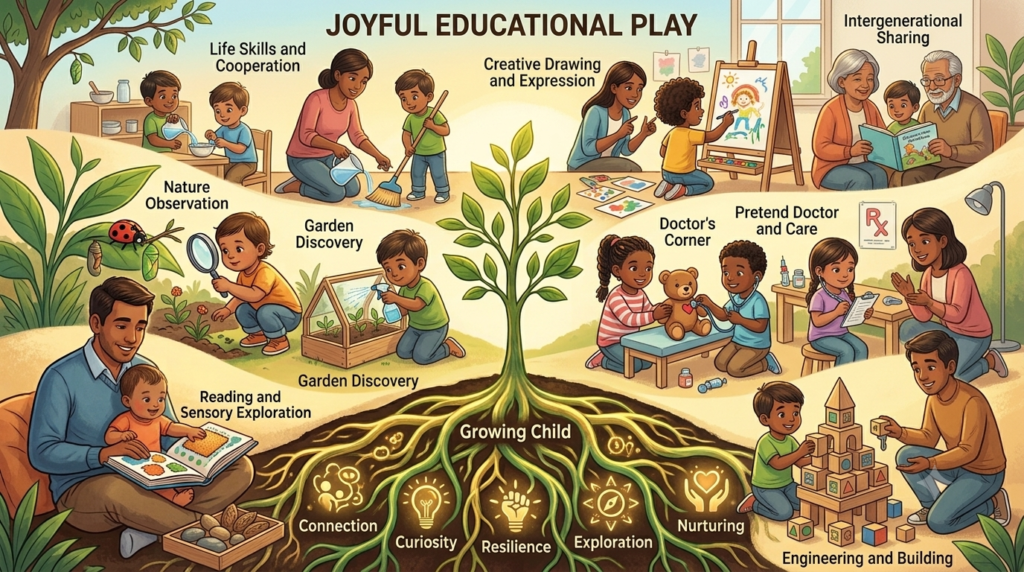
Understand the world around them
Test ideas safely
Express emotions
Develop creativity
Practice social skills
Play is not separate from learning.
Play is one of the primary ways children learn.
Children may forget what we tell them, but they rarely forget what we show them.
— Namaora Thought
What Children Learn Through Play
Problem-Solving Skills
When building with blocks, solving puzzles, or creating games, children learn to think critically.
They ask:
What works?
What doesn’t work?
What should I try next?
These are the foundations of problem-solving.
Creativity and Imagination
A cardboard box becomes a spaceship.
A stick becomes a magic wand.
A blanket becomes a castle.
Play allows children to imagine possibilities beyond what they see.
Creativity grows when imagination is given space.
Social Skills
During play, children learn:
Sharing
Cooperation
Negotiation
Leadership
Empathy
Many social skills cannot be taught through lectures.
They are learned through experience.
Emotional Development
Play helps children process feelings.
They explore:
Happiness
Frustration
Excitement
Fear
Confidence
Pretend play often allows children to express emotions they cannot yet describe with words.
Physical Development
Running.
Jumping.
Climbing.
Balancing.
Drawing.
Building.
All support physical growth and coordination.
Movement and learning work together.
Play vs Entertainment
Not everything that entertains a child helps them learn.
There is a difference.
Play
Active
Creative
Exploratory
Child-led
Interactive
Entertainment
Passive
Consumed
Often screen-based
Limited creativity
This does not mean all entertainment is bad.
But children need opportunities to actively participate, not just watch.
Why Modern Childhood Needs More Play
Today’s children face challenges previous generations did not experience.
Increased screen time
Structured schedules
Academic pressure
Less outdoor exploration
As a result, many children have fewer opportunities for free, imaginative play.
Yet this is exactly what many children need most.
7 Simple Ways to Encourage Meaningful Play
Reduce Over-Scheduling
Children need time to explore without constant instruction.
Provide Open-Ended Materials
Blocks.
Art supplies.
Building materials.
Natural objects.
These encourage creativity.
Spend Time Outdoors
Nature provides endless learning opportunities.
Allow Boredom
Boredom often sparks creativity.
Children frequently invent their best games when they have nothing planned.
Join Occasionally
Play with your child sometimes.
Follow their lead rather than controlling the activity.
Limit Unnecessary Screen Time
Balance digital activities with real-world experiences.
Celebrate Exploration
Focus less on outcomes and more on discovery.
What Great Educators Have Always Known
Many educational approaches, including Montessori education, recognize the importance of play, exploration, movement, and hands-on learning.
Children learn best when they are actively engaged.
Learning becomes meaningful when children experience it rather than simply memorizing it.
Key Takeaways
- ✓ Play is one of the most powerful forms of learning.
- ✓ Children develop cognitive, social, emotional, and physical skills through play.
- ✓ Creativity grows through exploration.
- ✓ Play helps children solve problems and build confidence.
- ✓ Free play is just as important as structured learning.
- ✓ Play prepares children for life, not just school.
Pause & Reflect
Think about your child’s day.
How much time is spent:
Learning through experience?
Exploring?
Creating?
Imagining?
Playing freely?
Could there be more opportunities for meaningful play?
The Namaora Thought
When children play, they are not escaping learning. They are often doing their most important learning.
Continue Your Learning Journey
Every game, conversation, story, and experience helps shape a child’s future.
Explore more Namaora articles on early learning, child development, parenting, and future-ready skills.
Next Recommended Article
👉 How to Reduce Screen Time Without Daily Arguments
This creates a natural progression:
0–6 Foundation → Play-Based Learning → Digital Wellness
and strengthens Namaora’s core educational philosophy.