Is School or Play School Necessary Before Age 6?
One of the Most Common Questions Parents Ask
As children approach preschool age, many parents begin to worry.
Questions start appearing:
Should my child join play school?
Will they fall behind if they stay at home?
Is preschool necessary?
What if my child is shy?
What is the right age to start school?
These concerns are understandable.
Every parent wants to make the best decision.
But before choosing a school, it helps to understand one important truth:
Children are learning from the moment they are born.
Learning does not begin on the first day of school.
Learning begins through relationships, observation, play, movement, conversation, and everyday experiences.
In This Article
✓ What children really need before age six
✓ Benefits of play school
✓ Benefits of learning at home
✓ Common myths about early education
✓ How to decide what is right for your child
The Most Important Fact About Ages 0–6
During the first six years, children learn rapidly.
They learn:
Language
Communication
Social behavior
Emotional regulation
Movement
Curiosity
Problem-solving
Independence
Most of this learning happens naturally through daily experiences.
This means that education is already happening before formal schooling begins.
Children may forget what we tell them, but they rarely forget what we show them.
— Namaora Thought
What Is the Purpose of Play School?
Many parents believe play school exists to teach academics.
In reality, the best play schools focus on:
✓ Social interaction
✓ Communication
✓ Routine
✓ Independence
✓ Exploration
✓ Play-based learning
✓ Emotional development
A quality preschool should help children learn how to learn.
Not simply memorize information.
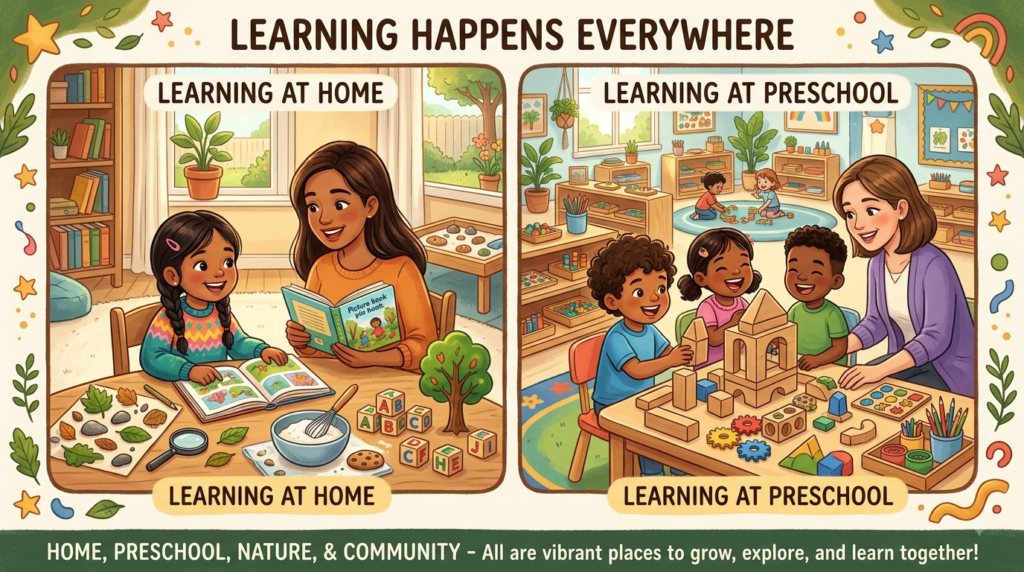
What Children Can Learn at Home
A child who stays at home can still learn tremendously.
Through:
Reading together
Conversations
Play
Nature walks
Household activities
Art and creativity
Storytelling
Children learn constantly when adults intentionally involve them in everyday life.
A home can be a powerful learning environment.
The Real Benefits of Play School
Social Interaction
Children learn to:
Share
Take turns
Cooperate
Communicate
These experiences help build confidence.
Independence
Children learn to:
Follow routines
Organize belongings
Make simple decisions
Manage small responsibilities
Exposure to New Experiences
New materials.
New friends.
New activities.
New environments.
These experiences support growth.
Learning From Other Children
Children often learn as much from peers as they do from adults.
Observation is one of childhood’s greatest learning tools.
The Real Benefits of Learning at Home
Individual Attention
Parents can follow the child’s pace and interests.
Flexible Learning
Learning can happen naturally throughout the day.
Strong Family Connection
Children spend more time interacting with parents and caregivers.
Real-Life Learning
Cooking.
Gardening.
Shopping.
Cleaning.
Daily life becomes the classroom.
Common Myths About Play School
Myth 1
“If my child doesn’t go to play school, they will fall behind.”
Not necessarily.
Children develop at different rates.
A rich home environment can provide many valuable learning experiences.
Myth 2
“Earlier academics create smarter children.”
Research and experience suggest that play, language, relationships, and exploration are often more important than early academic pressure.
Myth 3
“Play school guarantees success.”
No school can guarantee success.
Children thrive when they have supportive relationships, opportunities to learn, and environments that encourage growth.
When Play School May Be Helpful
Play school may be particularly beneficial when:
✓ A child enjoys social interaction
✓ Parents need childcare support
✓ The school follows a play-based approach
✓ Children have opportunities for exploration and movement
✓ The environment feels nurturing and safe
What Matters More Than School
Many parents focus on:
Which school?
But the more important question is:
What experiences is my child having every day?
Children need:
✓ Love
✓ Conversation
✓ Play
✓ Movement
✓ Reading
✓ Exploration
✓ Social interaction
✓ Emotional security
These experiences matter regardless of where learning happens.
A Better Question for Parents
Instead of asking:
“Is play school necessary?”
Ask:
“Is my child receiving the experiences needed for healthy development?”
That question often leads to better decisions.
Key Takeaways
- ✓ Learning begins long before formal schooling.
- ✓ Children learn through observation, play, and experience.
- ✓ Play schools can provide social interaction and independence.
- ✓ Home environments can also provide powerful learning opportunities.
- ✓ The quality of experiences matters more than the location.
- ✓ Every child develops differently.
- ✓ There is no single correct path for every family.
Pause & Reflect
Think about your child.
Are they receiving opportunities for:
Play?
Conversation?
Exploration?
Social interaction?
Independence?
The answers may matter more than the name of the school.
The Namaora Thought
Before children need classrooms, they need relationships. Before they need worksheets, they need experiences. Before they need academic pressure, they need opportunities to explore the world around them.
Continue Your Learning Journey
Continue Your Learning Journey
The early years are not a race.
They are a foundation.
Whether learning happens at home, in a play school, or through a combination of both, what matters most is that children are given opportunities to grow, explore, and thrive.
Next Recommended Article
👉 10 Practical Life Skills Every Child Should Learn Before Starting School
This is a perfect follow-up because it moves from “Where should children learn?” to “What should children learn before school?”, which aligns beautifully with Namaora’s Montessori and early childhood philosophy.