
Are YouTube and Instagram Shorts Affecting Your Child’s Attention Span?
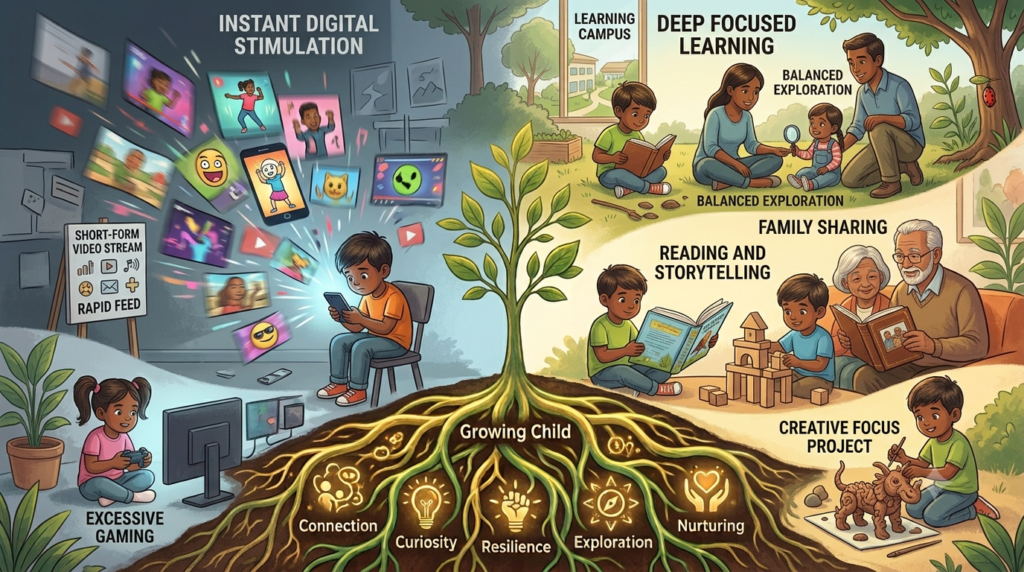
Why Can My Child Watch Shorts for Hours but Struggle to Focus for Five Minutes?
Many parents have noticed something unusual.
A child can watch dozens of short videos without losing interest.
Yet the same child may struggle to:
Read a book
Complete homework
Listen to a story
Finish a task
Stay focused during conversations
This often leaves parents wondering:
“Are short videos affecting my child’s attention span?”
The answer is more complex than a simple yes or no.
Short-form content is not automatically harmful.
However, excessive exposure can influence how children expect information, entertainment, and learning to be delivered.
In This Article
✓ Why Shorts and Reels are so appealing
✓ How attention works in children
✓ Potential risks of excessive short-form content
✓ Warning signs parents should watch for
✓ Practical ways to build healthy attention habits
Why Shorts and Reels Are So Attractive
Platforms such as:
YouTube Shorts
Instagram Reels
Facebook Reels
Similar short-video platforms
are designed to keep viewers engaged.
Each video offers:
✓ Something new
✓ Instant entertainment
✓ Fast rewards
✓ Constant novelty
✓ Minimal effort
Every swipe promises something interesting.
The brain quickly learns:
“The next video might be even better.”
Children may forget what we tell them, but they rarely forget what we show them.
— Namaora Thought
Understanding Attention
Attention is like a muscle.
It grows stronger through practice.
Children develop attention when they:
Read books
Build things
Solve problems
Play creatively
Listen to stories
Engage in conversations
These activities require sustained focus.
Short-form content works differently.
It trains the brain to expect:
Frequent stimulation
Rapid changes
Instant rewards
Constant novelty
Over time, some children may find slower activities less appealing.
The Real Concern Is Not Screen Time Alone
Many parents focus only on the amount of screen time.
But quality matters too.
Consider:
Child A
30 minutes reading.
30 minutes drawing.
30 minutes outdoor play.
30 minutes educational videos.
Child B
2 hours of nonstop short-form videos.
The total screen time may not tell the whole story.
The type of digital experience matters.
Signs Your Child May Need More Attention-Building Activities
Watch for patterns such as:
✓ Difficulty sitting through stories
✓ Frequently switching activities
✓ Constant need for entertainment
✓ Losing interest quickly
✓ Complaints of boredom
✓ Frustration with tasks requiring patience
These signs do not automatically mean there is a problem.
But they may indicate a need for more balanced experiences.
Why Boredom Is Important
Modern childhood often eliminates boredom.
The moment a child feels bored, a device appears.
Yet boredom plays an important role.
Boredom often leads to:
Creativity
Imagination
Problem-solving
Independent thinking
Some of the best ideas begin when children have nothing planned.
What Parents Can Do
Create Daily Focus Activities
Examples:
Reading
Drawing
Puzzles
Building blocks
Craft projects
Start small.
Even 10–15 minutes helps.
Encourage Longer Forms of Content
Not all screens are equal.
Consider:
✓ Educational documentaries
✓ Storytelling videos
✓ Learning content
✓ Creative tutorials
These often support deeper engagement.
Protect Reading Time
Reading develops:
Focus
Imagination
Language
Patience
Books remain one of the best attention-building tools available.
Schedule Screen-Free Periods
Examples:
Meals
Family conversations
Outdoor play
Before bedtime
These moments strengthen real-world engagement.
Model Healthy Habits
Children observe adults.
If parents constantly check phones, children notice.
Attention habits are often learned through observation.
Encourage Open-Ended Play
Play naturally develops concentration.
Children often focus for surprisingly long periods when deeply engaged in meaningful play.
Focus on Balance, Not Perfection
Technology is part of modern life.
The goal is not eliminating screens.
The goal is helping children develop the ability to focus, think, create, and engage with the real world.
A Simple Attention Formula
Every day try to include:
✓ Reading
✓ Play
✓ Movement
✓ Conversation
✓ Creativity
✓ Limited passive consumption
These experiences strengthen attention over time.
Key Takeaways
- ✓ Short-form videos are designed to capture attention.
- ✓ Excessive exposure may make slower activities feel less rewarding.
- ✓ Attention develops through practice.
- ✓ Reading, play, creativity, and conversation build focus.
- ✓ Boredom can be beneficial.
- ✓ Balance is more important than strict restrictions.
Pause & Reflect
Think about the last week.
How much time did your child spend:
Consuming content?
Creating something?
Reading?
Exploring?
Playing?
What small adjustment could create more balance?
The Namaora Thought
The future belongs not to those who consume the most information, but to those who can focus deeply enough to understand, create, and use it wisely.
Continue Your Learning Journey
In a world of endless scrolling, helping children develop attention may become one of the most valuable gifts we can offer.
Explore more Namaora articles on digital wellness, child development, early learning, and future-ready skills.
Next Recommended Article
👉 5 Skills Children Need More Than Marks in the Future
This is a perfect next article because it transitions from attention and focus into future readiness, one of Namaora’s most important content pillars.