
Is Technology Raising Our Children?
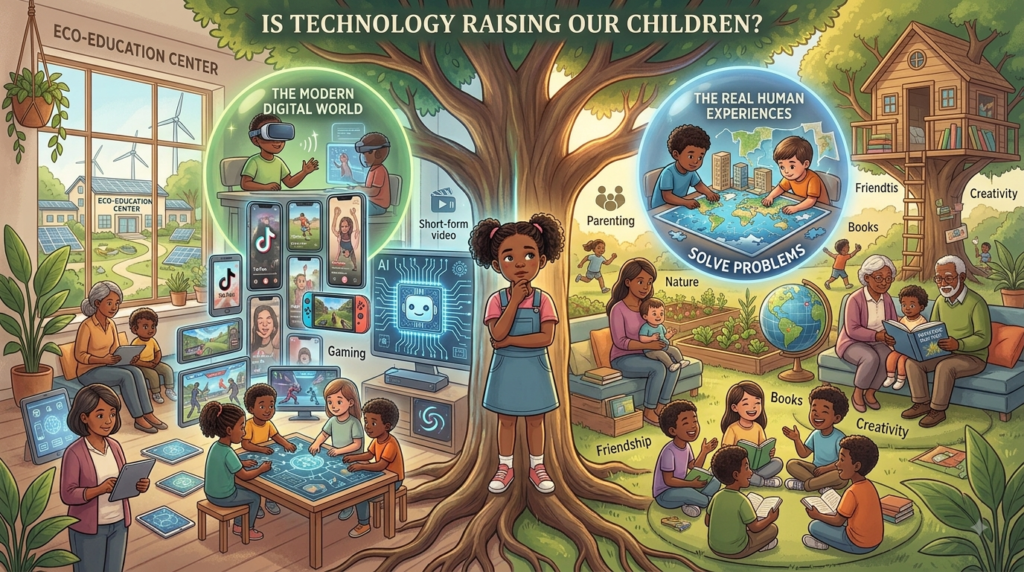
Who Is Raising Our Children Today?
A child wakes up.
A screen is nearby.
Breakfast comes with a video.
Free time becomes gaming.
Boredom becomes scrolling.
Questions are answered by search engines and AI.
Stories come from YouTube.
Entertainment comes from short videos.
And sometimes, when adults are busy, a screen becomes the easiest companion.
Technology has become deeply woven into childhood.
So it is worth asking an uncomfortable question:
Is technology raising our children?
The answer is not simply yes or no.
Technology can educate, connect, inspire, and create incredible opportunities.
But children also need something technology cannot replace:
human connection, real-world experiences, relationships, play, guidance, and observation.
In This Article
✓ How technology is changing childhood
✓ What technology can do well
✓ What technology cannot replace
✓ Warning signs of unhealthy dependence
✓ How parents and teachers can restore balance
✓ What future-ready digital parenting should look like
Technology Isn’t the Enemy
Let’s make one thing clear.
Technology is not bad.
In fact, children growing up today will need technology.
They will use:
Artificial Intelligence
Computers
Digital learning platforms
Online communication
Creative software
Smart devices
Digital tools we haven’t even invented yet
Trying to completely remove technology from childhood is neither realistic nor necessarily desirable.
The question is not:
“How do we keep children away from technology?”
The better question is:
“How do we teach children to use technology without allowing technology to control them?”
Children may forget what we tell them, but they rarely forget what we show them.
— Namaora Thought
The Real Problem: When the Tool Becomes the Teacher
A smartphone can teach a child how to draw.
YouTube can explain how planets work.
AI can help a student understand mathematics.
An educational app can make learning interactive.
These are powerful possibilities.
But technology cannot replace:
A parent’s hug.
A teacher noticing a child’s emotions.
A friend learning to cooperate.
Outdoor exploration.
Imaginative play.
A meaningful conversation.
A child discovering something independently.
Technology can support these experiences.
It should not replace them.
Children Learn From What They Observe
This is one of Namaora’s most important ideas.
Children don’t only listen to us.
They watch us.
If parents constantly check their phones during conversations, children observe it.
If adults reach for a device whenever they feel bored, children notice.
If family meals happen around screens, children learn that screens belong at the center of family life.
And if parents put their devices away and engage with the people around them…
Children notice that too.
The lesson is simple:
Digital habits are taught as much through observation as through rules.
What Technology Does Well
Technology can give children extraordinary opportunities.
Learning
Children can explore:
Space
Science
Languages
History
Mathematics
Art
Creativity
Technology can help children:
Make videos
Create music
Draw
Code
Design
Build
Accessibility
Digital tools can provide learning opportunities for children who may not otherwise have easy access to certain resources.
Connection
Technology can help families and children stay connected across distances.
The goal isn’t to reject these benefits.
The goal is to use them intentionally.
What Technology Cannot Replace
There are some things children need to experience in the real world.
Human Connection
A conversation teaches more than words.
It teaches empathy, listening, expression and relationships.
Physical Play
Running, climbing, building, touching, balancing and exploring develop the body and mind together.
Nature
A real tree is different from a picture of a tree.
Nature provides sensory experiences that screens cannot reproduce.
Imagination
When everything is provided on a screen, children have fewer opportunities to create their own worlds.
A cardboard box can become a spaceship.
A blanket can become a castle.
That kind of imagination is valuable.
The “Digital Babysitter” Trap
Sometimes parents use screens because they are exhausted.
And that’s understandable.
Parents have responsibilities.
Work.
Household tasks.
Stress.
Sometimes a screen gives everyone a few quiet minutes.
There is no need for parental guilt.
The problem begins when the screen becomes the default solution for every emotion and every situation.
Bored?
Screen.
Hungry?
Screen.
Crying?
Screen.
Waiting?
Screen.
Traveling?
Screen.
Over time, children may have fewer opportunities to learn how to:
Wait
Communicate
Manage boredom
Solve small problems
Play independently
5 Questions Every Parent Should Ask
Before giving a child a device, ask:
Why are we using it?
Learning?
Communication?
Entertainment?
Habit?
What is my child doing with it?
Creating?
Learning?
Talking?
Or simply consuming?
What is technology replacing?
Reading?
Playing?
Sleeping?
Conversation?
Outdoor activity?
Can my child stop without a major struggle?
If stopping consistently creates intense conflict, the family may need to rethink the routine.
Am I modelling the behavior I expect?
This may be the most important question.
A Better Digital Parenting Approach
Instead of:
“No screens!”
Try:
“Let’s use technology wisely.”
Instead of only setting restrictions, teach:
Purpose
Why are we using this device?
Balance
What else should we do today?
Responsibility
Can we stop when it’s time?
Awareness
How does this content make us feel?
Creation
Can we use technology to create something?
This moves children from passive consumers to responsible digital citizens.
Technology + Human Learning
At Namaora, we believe the future isn’t:
Human vs Technology.
It is:
Human + Technology
A child should be able to use AI and think independently.
Use a tablet and enjoy a book.
Watch educational content and explore nature.
Use digital tools and create something with their hands.
Learn online and learn from people.
That’s what future-ready education should look like.
A Simple Daily Balance
Rather than obsessing over one number, look at the whole day.
Does your child have opportunities for:
🌱 Outdoor exploration
📖 Reading
🎨 Creativity
🧩 Problem-solving
🏃 Physical movement
💬 Family conversation
👫 Social interaction
💻 Purposeful technology
😴 Healthy sleep
The goal is not a perfect schedule.
The goal is a balanced childhood.
Parents Don’t Need to Compete With Technology
This is important.
Parents sometimes feel:
“My child knows more about technology than I do.”
That’s okay.
You don’t need to know every app.
You don’t need to understand every game.
You don’t need to become a technology expert.
Your role is different.
You provide:
Values.
Boundaries.
Context.
Connection.
Wisdom.
Technology can provide information.
Parents help children understand what to do with that information.
For Teachers
Teachers face the same challenge.
Technology can make classrooms more engaging.
But technology should not replace:
Discussion
Collaboration
Hands-on learning
Creativity
Observation
Teacher-student relationships
A smart classroom isn’t necessarily one with the most devices.
A smart classroom is one where technology is used purposefully.
Key Takeaways
- ✓ Technology is not the enemy.
- ✓ Children need digital skills for the future.
- ✓ Technology should support—not replace—human relationships.
- ✓ Children learn digital habits by observing adults.
- ✓ Passive consumption should not dominate childhood.
- ✓ Real-world play, nature, reading and conversation remain essential.
- ✓ Parents should focus on balance rather than guilt.
- ✓ Teachers can use technology without allowing it to replace human learning.
Pause & Reflect
Tonight, don’t ask your child:
“How much screen time did you have?”
Instead, ask yourself:
“What did the screen replace today?”
Did it replace:
A conversation?
Outdoor play?
Reading?
Boredom?
Sleep?
Or did it provide something genuinely useful?
That question may tell you more than the screen-time number alone.
The Namaora Thought
Technology can give children information, but childhood still needs imagination, relationships, experiences, and human guidance.
Continue Your Learning Journey
Technology will continue to change.
AI will continue to evolve.
The devices children use tomorrow may look completely different from the ones we use today.
But one thing will remain:
Children will still need people who help them understand the world.
Namaora exists to help parents, teachers, and children navigate that changing world together.
Next Recommended Article
Why Modern Classrooms Must Teach Curiosity, Not Just Content
This creates a very strong Namaora content journey:
Technology → Digital Wellness → Education → Curiosity → Future Skills
And importantly, this article gives us a bridge between parents and teachers, which is exactly what Namaora should be known for.